
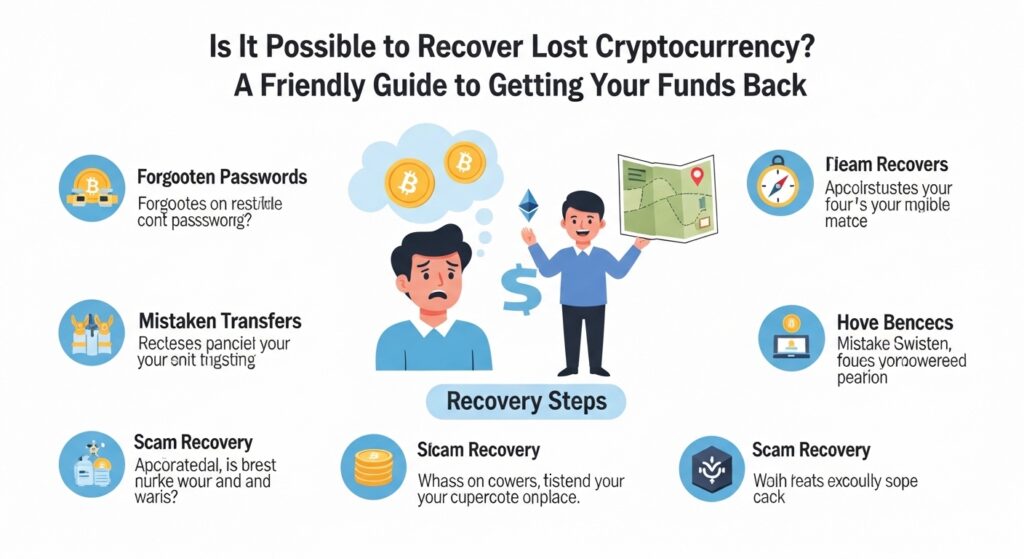
Can You Really Recover Stolen or Lost Cryptocurrency? A Clear Guide to Getting Your Funds Back crypto recovery service
Hey there, crypto enthusiasts and cautious investors! If you’ve ever found yourself wondering, “Can stolen cryptocurrency be recovered legally?” or stressing over sending coins to the wrong wallet, you’re definitely not alone. The fast-moving world of digital assets can sometimes trip us up, whether it’s due to scammers, simple human error, or the ever-present risk of hacks. But here’s the hope: Your crypto might not be gone forever. This week, we’re diving into how blockchain forensic investigations work, the essential steps to take after a crypto scam, and whether you can retrieve funds mistakenly sent to a wrong address. Grab your coffee (or crypto wallet) and let’s unravel the mysteries together.
Is It Possible to Recover Stolen Cryptocurrency Legally?
The brutal truth? Recovering stolen cryptocurrency isn’t straightforward, but it’s not impossible either. Unlike traditional banking systems, cryptocurrency transactions are decentralized and irreversible by design. Once the money moves, there’s no “undo” button. Still, legal avenues and investigative techniques have evolved dramatically in recent years. Authorities and private cybersecurity firms have been sharpening their tools to combat theft and fraud in the crypto space.
Legally, recovery depends heavily on cooperation with law enforcement, blockchain analysts, and sometimes ethical hackers who can trace stolen tokens through the blockchain’s public ledger. If the thief tries to cash out on a regulated exchange or mix coins through mixers, there might be a trail to follow. Also, jurisdiction matters—some countries have stronger enforcement mechanisms and legal support than others.
Bottom line: If your crypto got swiped, don’t lose hope immediately, but be prepared for a possibly lengthy and complex process. Prompt action and the right support can dramatically improve your chances.
How Blockchain Forensic Investigations Work for Fund Recovery
So, how does one even begin to find stolen crypto on a blockchain that’s designed to be anonymous yet transparent? This is where blockchain forensic investigations come into play. Think of forensic blockchain experts as high-tech detectives who track irregular money flows across the blockchain’s public ledger.
Here’s a quick rundown of how they operate:
- Transaction Tracking: Each crypto move is recorded on a blockchain. Analysts use specialized tools to follow the chain of transactions, from the victim’s wallet to wherever the thief tries to move the funds.
- Address Clustering: They group addresses likely controlled by the same entity, helping to identify wallets belonging to exchanges, mixing services, or even the culprit.
- Exchange Collaboration: Since real-world identity checks happen at regulated exchanges, investigators reach out to these platforms to obtain information about account holders who try to cash out stolen crypto.
- Behavioral Analysis: Patterns in transaction timing, size, and type can help identify money laundering or cover-up attempts.
This process is equal parts tech deep dive and detective work, combining blockchain immutability with human ingenuity. While not foolproof, blockchain forensics has undone some of the biggest frauds in recent years.
Steps to Take After Falling Victim to a Crypto Investment Scam
Getting cheated out of your hard-earned crypto is devastating, but immediate and informed action can make all the difference. Here’s a quick guide on what to do if you suspect you’ve been scammed:
- Stop Further Transactions: Avoid sending more funds or sharing sensitive keys. Cut off all communication with the scammer.
- Document Everything: Save emails, chat logs, transaction records, and any correspondence. These will be invaluable for investigations.
- Report the Incident: Contact your local law enforcement, financial regulators, or cybercrime units. Many countries now have dedicated agencies for cyber fraud.
- Notify Exchanges and Wallet Providers: If you know where the stolen funds might be headed, alert these platforms to freeze suspicious accounts if possible.
- Consult Blockchain Forensic Services: Specialized companies can analyze transaction trails and may help trace or recover funds for a fee.
- Warn Others: Share your experience on forums or social media to prevent others from falling prey to the same scheme.
Remember, while these steps might not guarantee full recovery, they improve your chances and contribute to the broader fight against crypto crimes.
Is It Possible to Recover Crypto Sent to the Wrong Wallet?
Ah, the classic “Oops! I sent crypto to the wrong wallet” panic. This mistake is surprisingly common, especially with complex addresses and multiple currencies. Unfortunately, since blockchain transactions are irreversible, if you send funds to an incorrect address—even a single mistyped character—the coins are usually lost for good.
However, there are a few caveats:
- If the Wallet Belongs to Someone You Know: The easiest scenario. Reach out and politely request a refund.
- If It’s an Exchange Address: Sometimes exchanges can reverse the transaction if you act quickly and have proof.
- Technical Errors Within Your Wallet Service: If the wallet provider made an error, they might help.
Otherwise, the deeper the blockchain is confirmed, the harder retrieval becomes. Always double-check addresses each time you send crypto and consider sending a small test amount first.
Wrapping It Up: What You Can Do Now
Crypto recovery is a field that blends cutting-edge technology, legal frameworks, and community vigilance. While the decentralized, irreversible nature of blockchain poses real challenges, growing expertise in forensic investigations and increasing regulation are tilting the scales in favor of victims. If you find yourself dealing with stolen or lost crypto, act fast: gather evidence, report promptly, and seek expert help.
Next week, we’ll explore how decentralized finance (DeFi) platforms are improving investor security and what new tools you can use to safeguard your assets in this dynamic ecosystem. Until then, stay curious, stay vigilant, and keep enjoying the fascinating world of crypto!
Thanks for reading and being part of this community—remember, every question you ask and every experience you share makes the space safer and smarter for all of us.